The Architect Behind the Palazzo Vecchio

Subscribe to my free Substack Newsletter, Field Guide to Italian Art!
If you have been to Florence or even seen a photo of the city, you have seen Arnolfo di Cambio's masterpieces. About one hour almost directly south of Florence lies Colle di Val d’Elsa, the birthplace of Arnolfo di Cambio. It is a great base to explore Chianti, Siena, and other sites. The town's name means Hill of the Valley Elsa. The town and surrounding countryside features a true Tuscan slice of life. Historically, rival towns Siena and Florence fought over the town for control.

Arnolfo di Cambio's name has slipped into the archives of history, unoticed by modern tourists. In his day, he was an innovator architect and sculptor. Arnolfo was the architect responsible for Florence’s Duomo, the imposing Palazzo Vecchio, and the Palazzo d’Arnolfo in San Giovanni Valdarno.
Subscribe to my free Substack Newsletter, Field Guide to Italian Art!

Arnolfo’s iconic masterpieces are in Tuscany and Florence. He is credited as the initial architect of Florence’s Duomo in 1296. He died five years later, and we are uncertain how much of his design remained unchanged. Teams of artists continued work on the Duomo. He envisioned a structure with a commanding dome, and Filippo Brunelleschi built it more than a century later. Arnolfo planted the seed for the iconic church.
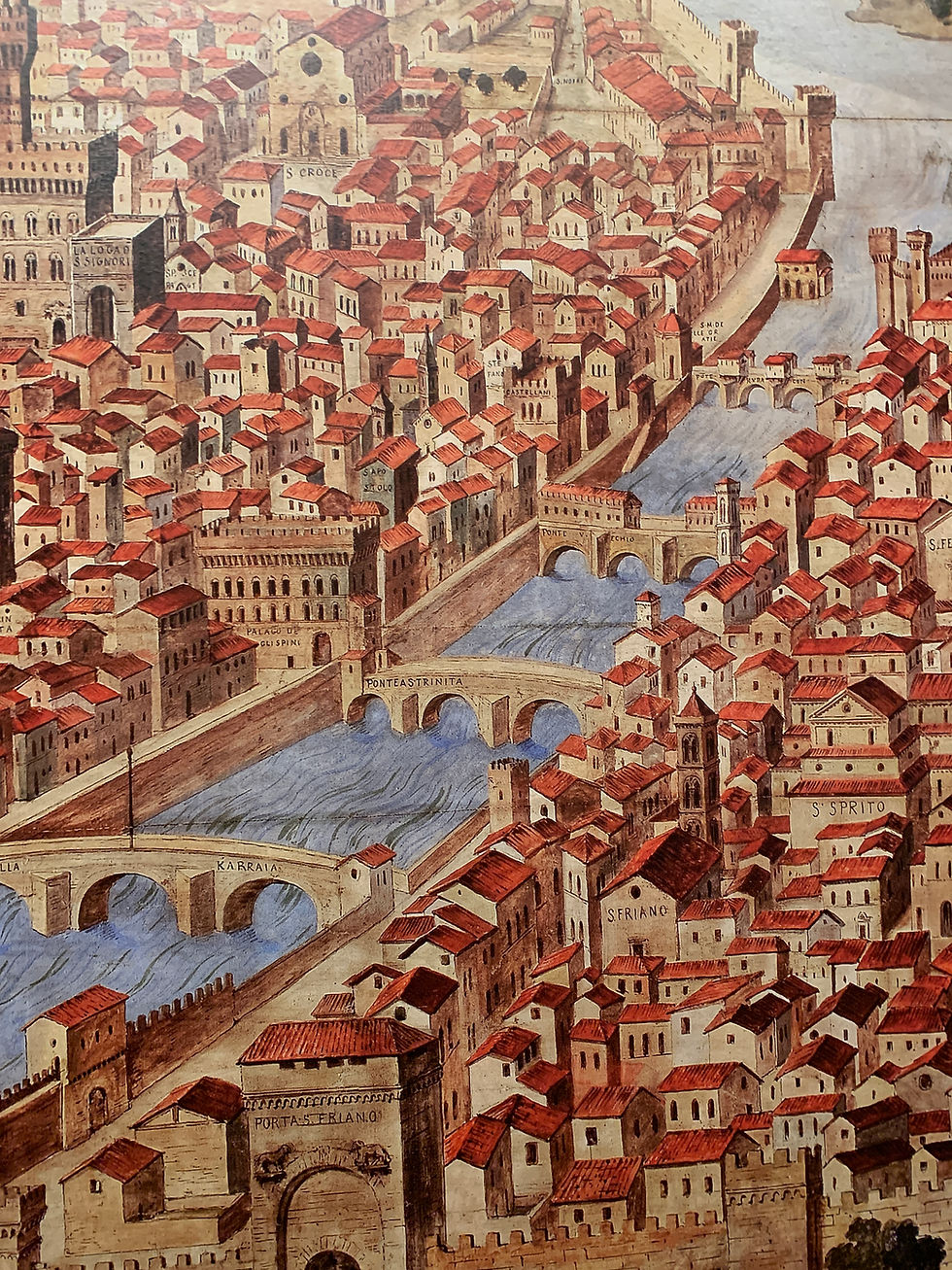
The impressive Palazzo Vecchio in the heart of Florence was built in only eleven years, from 1299-1310, a considerable pre-industrial era achievement. Although completed after his death, it is Arnolfo’s design. Known initially as Palazzo dei Priori, it was the seat of Florentine government until the Medici claimed it as their family residence in 1540. Arnolfo succeeded in designing a building that projected power, security, and stability.

Made of locally sourced limestone, the exterior consists of rusticated blocks, with a rough texture, giving it an impenetrable appearance. Crenellations on top provide protection in case of an attack and are typical of medieval civic architecture. Mullioned windows with trefoil arches lighten the heaviness of the rustication and add some flair. French Gothic architecture inspired their design.
The Palazzo Vecchio, with its offset tower, dominates the Piazza della Republica. Arnolfo’s tower is visible from vantage points, and along with the Duomo and the bell tower, are iconic symbols of the city.
Civic leaders created the Piazza della Republica after destroying houses owned by a traitorous family. The Uberti family picked the wrong side in a conflict. They fought with Siena against Florence in the thirteenth century. The republic confiscated and tore down their property, and vowed to build nothing there again to set an example for disloyal citizens.
Arnolfo’s iconic architectural masterpiece became the backdrop for sculptures in the piazza, most notably, the placement of Michelangelo’s David in 1504.
Sources
Hartt, Frederick and David G. Wilkins. History of Italian Renaissance Art. Seventh edition. Prentice Hall, 2011.
Paoletti, John T. and Gary M. Radke. Art in Renaissance Italy. Fourth edition. Laurence King, 2011.