Roman Glass: From the Beach to Table

Glass was to the Romans what plastic is to modern cultures. Romans were adept at large-scale enterprises. They conquered the Eastern Mediterranean to Britain, and with glass took manufacturing to new levels of production and design. Glass was remarkably versatile, allowing Romans to recycle it, form it into brilliant colors, inventive shapes, and intricate patterns.
Romans used glass for mosaic decoration, vessels, window panes, lamps, plates, bowls, in jewelry, and for personal care products. In the Roman Empire, glass was ubiquitous. Four things were necessary for Romans to make glass throughout the empire: skilled labor, the right raw materials (quartz sand, calcium carbonate, and natron), lots of fuel for furnaces, and creativity.
Not just any sand from a beach or river would do. The best Italian sand came from beaches in the southern Basilicata region, Apulia, and some parts of western Tuscany. Other suitable raw materials were found in select areas of Spain, France, Egypt, Palestine, and other territories. Glassmakers could produce a surprising number of objects, about 100 vessels a day. They worked seasonally, creating as estimated 11,000 objects a year. Producers ran small family workshops rather than large-scale factories. Trade routes in the empire were necessary to obtain the right materials and to market and sell finished goods.

Like all objects, glass could be a sign of wealth and status. Roman homes were displays of wealth intended to project harmony and happiness. Home decoration created a mindset of joy and prosperity with frescoes, mosaics, and tableware. Glass played a part in creating this environment, with color and design combined with function. Glass could be cast in molds, or blown. Styles and colors gained and ebbed in popularity. Uncolored glass was in vogue from about 50-100 CE, as it could easily be melted down for reuse. Roman glass emphasized new shapes and different color combinations over traditional glass from Greece and the Near East.
Ribbons of colored glass with zig-zags, spirals, or undulating patterns were popular. To make a multi-colored cast bowl, different colored glass canes were assembled in the desired combination, then fused together to form a flat surface in the shape of a doughnut: a circle with a small hole in the middle. The glass circle was placed in a mold and allowed to soften in a furnace or kiln until the glass took the shape of the mold. Romans preferred intricate patterns of twisted glass canes, sometimes intertwined with gold leaf. Glassmakers also used lathes to achieve the desired shape and finish.
The evolution from cast or molded glass to blown glass allowed glass to become everyday items in the Roman Empire. Commercial glassblowing was born out of necessity and Roman inventiveness. Blowing molten glass through clay and later iron pipes allowed for original shapes and sizes. Blown glass is thought to have originated late in the first century BCE and only became the primary production method about 200 years later. Glass virtually replaced metal and ceramic tableware for convenience and cost. Even with small family-run workshops, Romans could scale up blown glass production surprisingly fast. Decorative glass was even used for wall revetments, which was certainly a very fragile, albeit stunning, way to finish a wall.
Glass Garland Bowl, Roman, Late 1st Century BCE,
Metropolitan Museum of Art, New York, open access.
A seven-inch diameter Garland Bowl is an exquisite example of Roman glass artistry. This bowl is the only extant Roman four-color bowl with a millefiori design. Colorless, red-purple, golden yellow, and deep blue glass make up the four quadrants of the bowl. Each section has a garland, with no two alike. A string suspends each garland at the top of the curved surface, creating the effect of the garland suspended against the concave surface. The four colored sections were placed in a mold, and fused together. After the four sections were fused in the mold, the garlands were added. The garlands are made from a technique called millefiori—thousand flowers. Tiny canes of different colored glass are fused together, then cut and shaped into the desired pattern and placed in the mold. The piece is returned to the furnace where the millefiori garlands fuse into the bowl.
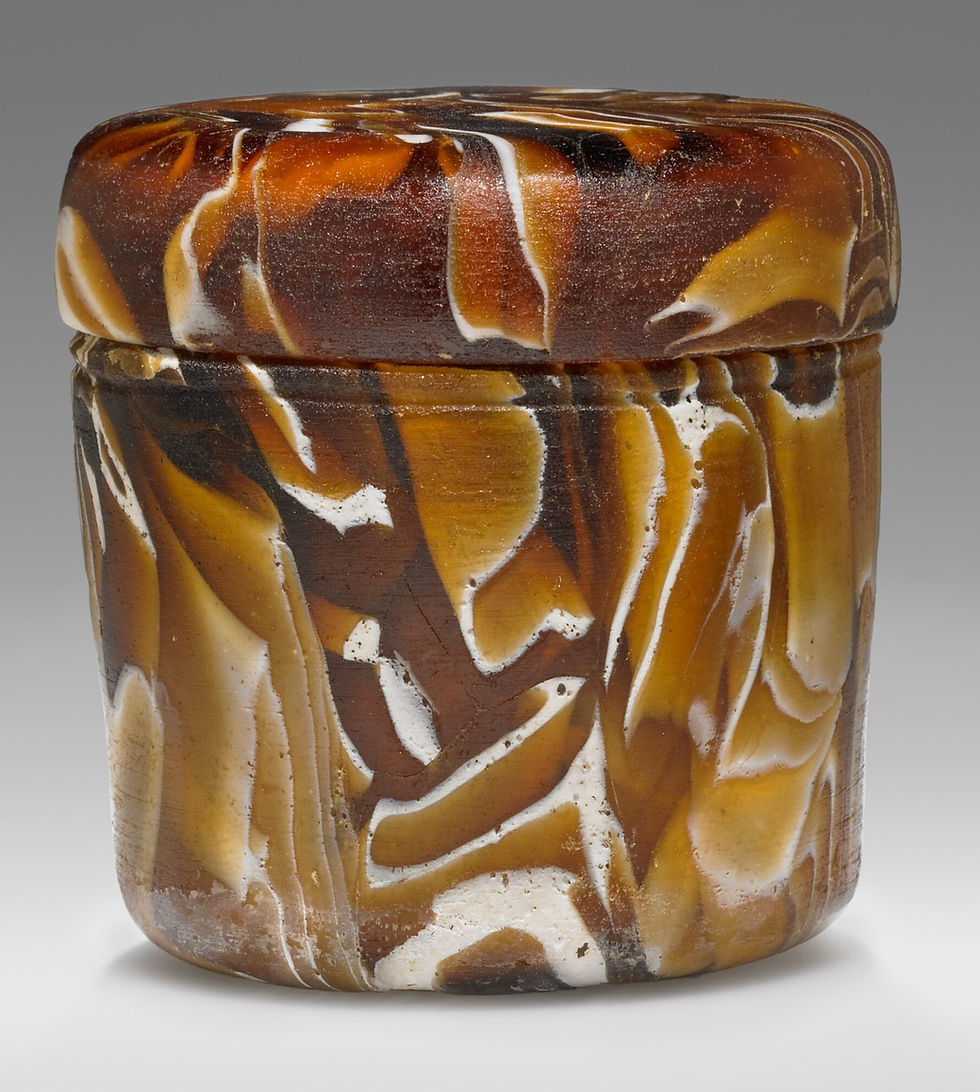
A Lidded Pyxis was made with canes of gold and amber glass intertwined with white glass. Canes were cut in polyangular shapes, set in the mold, and fused together. The finished result resembles an agate. Romans were especially keen on imitating nature in glassware. A pyxis is a small jar used for jewelry, ointment, or cosmetics. At only two inches high, only a skilled glassmaker could cut the thin canes and fuse them together in a pleasing pattern. Elaborately decorated glass jars like this were often buried along with the belongings of a deceased person.

Sipping wine from an engraved cameo glass would have impressed Romans at a banquet. This blue skyphos, or large drinking cup, was made from free-blown glass. After cooling, molten opaque white glass was trailed or dipped over the blue. Before cooling completely, a skilled engraver carved the mythological figures and scenes into the white glass. The skyphos was polished and finished on a lathe. Hand tools and rotary grinding tools were used to incise the white glass. The figures depict Ariadne’s initiation into the cult of Bacchus. The white contrast on blue made for dramatic glassware, although sometimes purple glass was used as a base.
Cameo glass decorated urns for ashes of the deceased, jugs, bottles, vases, and other household items. Fragments of cameo glass tabletops give us an idea of lavish decorative uses. Wealthy Romans preferred cameo glass because of the skill and time required to make a cameo piece. Romans did not invent the cameo process, but popularized it and expanded its use on everyday objects. Islamic artists made beautiful cameo glass, although with different techniques, which speaks to the widespread popularity of incised glassware. Cameo glass inspired the eighteenth-century English potter Josiah Wedgwood’s iconic blue and white pottery.
Stolen Glass?
The Lidded Pyxis and many other ancient objects have a sketchy or missing provenance, or ownership history. This suggests the item may have been taken illegally from burial sites and sold, which was quite common. Criminal networks of tomb raiders, so-called art collectors, and dealers sold ancient objects to many American museums, private collectors, and auction houses. Few questioned the origin or asked for ownership records.
Some red flags for potential stolen art work include: a provenance that consists of only a few recent owners or galleries; the object was acquired mid-twentieth century-2010s; a Swiss dealer or gallery is listed as an owner mid to late twentieth century prior to the museum’s acquisition; the findspot is unknown or vague, i.e. southern Italy, made in Greece, or said to be from Italy.
The four glass objects in this post all raise provenance red flags. None list a findspot. The pyxis glass jar’s first documented owner in the mid-1970s bequeathed it to his son until purchased by the Getty in 2003. The Cameo Glass Skyphos cup’s first documented owner in the early 1980s sold it a few years later to the Getty. The Metropolitan Museum of Art acquired the Garland Bowl in the late nineteenth century from an art collector and benefactor of the museum.
The Italian Ministry of Culture actively investigates and pursues legal action to return stolen and trafficked art. In 2022, the Getty returned some artwork to Italy after the Italian Ministry of Culture questioned its illegal excavation. The Metropolitan Museum of Art has also repatriated art to Italy. In 2024, American museums repatriated 600 illegally obtained objects to Italy. In 2025, the San Antonio Museum of Art repatriated nine artworks to Italy.
Looted artwork—not just from Italy—is a shameful stain on museums and art auction houses. Ethical issues surrounding acquisition and provenance have come to the forefront, especially following high-profile cases at the Getty and the Met. These museums, and others, sometimes now list the provenance of artworks on their websites.
I applaud the transparency of the Met Museum Repatriated Objects and their Nazi-Era Provenance Research.
Interesting Resources
Interpol Stolen Works of Art Database art trafficking is big business
The Antiquities Coalition fighting cultural racketeering
Sources
Brems, D., and P. Degryse. “Western Mediterranean Sands for Ancient Glass Making.” In Glass Making in the Greco-Roman World: Results of the ARCHGLASS Project, edited by Patrick Degryse, 27–50. Leuven University Press, 2014.
Degryse, P., M. Ganio, S. Boyen, et al. “Primary Glass Factories around the Mediterranean.” In Glass Making in the Greco-Roman World: Results of the ARCHGLASS Project, edited by Patrick Degryse, 97–112. Leuven University Press, 2014.
.
Grose, David. “The Formation of the Roman Glass Industry.” Archaeology 36, no. 4, 1983, 38–45.
Luckner, Kurt T. “Ancient Glass.” Art Institute of Chicago Museum Studies 20, no. 1, 1994, 79–91.
Stern, E. Marianne. “Roman Glassblowing in a Cultural Context.” American Journal of Archaeology 103, no. 3,1999, 441–84.
Zanker, Paul. Roman Art. Translated by Henry Heitmann-Gordon. Getty Publications, 2010.


