How to Become a Renaissance Artist

How did the son of a tanner and a son of a notary change the art world? Sandro Botticelli and Filippo Brunelleschi are perfect examples of artists from humble origins.
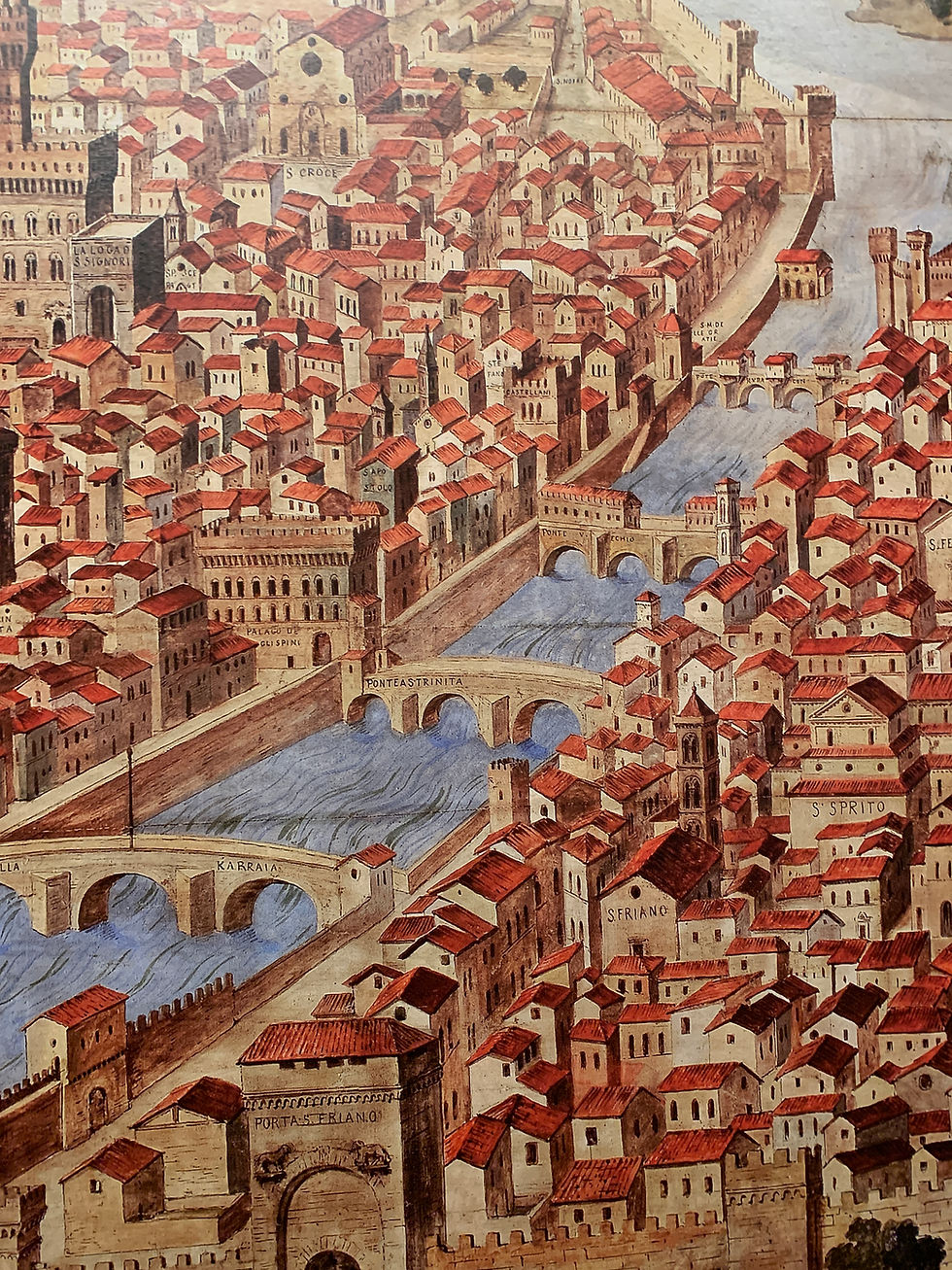
Their success rested on social mobility, a capitalistic economy, and freedom to choose. (It also helped to be born male.) Florence was the epitome of culture with an educated population, and wealthy patrons. It was a center of innovation, the largest city in Italy, and the most urbanized in Western Europe. Its thriving textile trade and banking industry provided a stable economy.
Besides talent, cultural and organizational forces nurtured artistic innovation. Organizationally, guilds, textile industry, and banking had a lot to do with becoming an artist. Culturally, social mobility, education, and paternal decisions made a difference.
Guilds were secular organizations providing a union-like training opportunity. There were twenty-one guilds for every occupation—from salt sellers to bankers. The most prestigious were affiliated with the textile industry, which employed about 30-40 percent of Florentines. The elite and powerful textile guilds funded the arts. One of the richest guilds was the Calimala, a guild for those who worked with raw imported cloth from Flanders. Without their financial support we would not have Lorenzo Ghiberti’s bronze baptistery doors. Likewise, without the patronage of the Arte della Lana guild for wool merchants, Filippo Brunelleschi would not have had funding for the cathedral dome.
Guilds exercised some control mechanisms on pricing, who could belong to the guild, and who could do business with whom. What made Florence different from other cities and countries was some regulation, but more flexibility. Some artists never got around to joining guilds, switched guilds, or weren’t particularly active. A tradition of hereditary guild membership was absent in Florence. If a father was a guild member his son had no obligation to follow in that guild or trade.

Tanner’s Son
Sandro Botticelli stands as a perfect example of how to become a Renaissance painter. Hardly any Florentine painters descended from a family of artists. He was born Alessandro Filipepi in 1445. Botticelli was a nickname for his brother, and Sandro took it as his surname.
Sandro’s father Mariano Filipepi was a tanner. Considered a lower-class trade, tanning was a stinky, messy job preparing animal hides. His father belonged to one of the four guilds associated with leather goods. Sandro was one of nine children born to his father and mother Smeralda. The family moved a lot in Florence and finally settled in a house in the Ognissanti neighborhood, where Sandro lived and worked for most of his life. They were by no means well-to-do. Sandro’s family situation was common; about sixty percent of Florentines struggled economically.
Sandro started school about age seven. A 1458 catasto (tax census) showed the teenage Sandro still in school. He would have learned what other Florentine boys learned: arithmetic, writing, reading, and basic skills that would serve them well as merchants, businessmen, or diplomats. They learned the vernacular Italian, not Latin, which was reserved for the aristocracy. Literacy rates were high and extended to the lower and working classes. Boys stayed in school until they were eleven or early teens. Students learned together from all socio-economic classes. Schools were keen on teaching arithmetic and bookkeeping. Florentines knew their accounting and kept pristine books. Keeping accurate records was a normal practice for Florentine businessmen. When artist Antonio del Pollaiuolo’s grandsons were called before a tribunal to defend their inheritance, they produced numerous account books recording the four partnerships their grandfather had established. The tribunal considered the account books legally binding evidence.
Families were well connected often in inter-related trades, including Botticelli’s family. If a family made brocaded fabric, they might marry a son to a banker’s family, or a tailor, or a daughter to a family associated with silk or pigments. There was mutual benefit from family connections, and the Botticelli brothers helped each other in their careers.
The tax census recorded Sandro’s much older 37-year-old brother as a banker in the upper-class guild for money merchants. Another brother, Antonio, belonged to the guild for goldsmiths. Another brother worked in the silk textile industry and belonged to the Arte della Seta guild. Soon after the tax record was taken, Sandro left school and began a brief apprenticeship as a goldsmith before training under painter and rogue friar, Fra Filippo Lippi.
As a fledging goldsmith, Sandro learned to draw. He honed his skills copying his master’s drawings, engravings, plaster and clay models, sculptures, and from live models. Artists would place fabric over clay or plaster models to study how material drapes and folds. Lippi’s tender representations of the Virgin Mary, baby Jesus, and color palette made an impression on Botticelli. He learned how to do basic tasks like grinding pigments and preparing surfaces, improve his drawing skills, and technical aspects of fresco and painting on wood panel.

Botticelli moved on to Andrea del Verrocchio’s workshop. Sandro worked there at the same time Leonardo da Vinci apprenticed. Verrocchio was a skilled goldsmith, sculptor, and painter. Botticelli could not have had a better foundation in skills and studio management. He was with Verrocchio for a few years until he opened his own studio and took on independent commissions, around 1467, in his early twenties. It was now his turn to oversee assistants, sign contracts, and manage commissions and supplies. He was at the beginning of a forty-three-year career painting for the rich and powerful of Florence. Botticelli’s Birth of Venus and Primavera became iconic images of the Florentine Renaissance. He excelled in religious and allegorical paintings and painted the first known portrait of a woman turned towards the viewer, not in profile.
Notary’s Son
Social mobility, relative freedom to choose one’s profession, and lack of parental interference helped form some outstanding artists. Fifteenth-century artists came from a wide variety of backgrounds. Painter Fra Bartolomeo’s father was a mule tender. The Dominican friar was a contemporary of Botticelli and a friend of Raphael. Antonio and Piero del Pollaiuolo were brothers who painted, sculpted, and made engravings. They ran a large, successful workshop and innovated in painted portraiture. Their father was a poultry producer, hence the play on their nickname in Italian, as pollo means chicken.

Leonardo da Vinci shared something in common with Filippo Brunelleschi: their fathers were notaries. Notaries were near the top of social standing and earnings. Artists were middling or closer to the lower quadrant. If Leonardo and Filippo were average artists, they would have fared better financially by following their father’s profession.
Guilds held some political clout but held little influence over choice of vocation or market needs. Enrollment in a guild was not a conscription to one vocation. Brunelleschi trained as a goldsmith and ended up an architect and master mason. By virtue of their resourcefulness, artists had additional freedom of occupation. At age fifteen, Brunelleschi’s apprenticeship to a goldsmith opened up many opportunities. Nine years later, at only age twenty-four, he entered a competition for Florence’s baptistry bronze doors. As a master metalworker, he was poised to take on a massive commission.
He was a finalist but lost the competition to Lorenzo Ghiberti. He moved to Rome for over a decade before returning to Florence. For decades, Florence had a building boom with the construction of palaces, churches, and homes. Artists responded to market needs and demand for construction and decoration. There was no greater social need in Florence than to finish Santa Maria del Fiore, the cathedral in the center of the city.
The problem of Florence’s dome had eluded architects for nearly a century, leaving the church open to the sky. No one could figure out how to build a dome so large yet structurally sound. The Opera del Duomo (cathedral works) opened a competition to construct the cathedral dome in 1418. Brunelleschi submitted a plan to build the dome with a radical design. Brunelleschi solved the problem by building a brick dome 171 feet above the floor with a 144-foot span, using a double shell supported by hidden stone and iron chains.

It would be the largest masonry dome ever built with a double-shell design. When Brunelleschi submitted his design to the Opera del Duomo, he was underqualified as an architect but presented just the right amount of entrepreneurial spirit and bravado to win the commission. His time in Rome observing architecture, particularly the Pantheon, provided inspiration and stimulated innovative ideas. Brunelleschi’s dome became the symbol of Florence and an inspiration for Michelangelo’s dome for St. Peter’s in Rome.
Sources
Ames-Lewis, Francis. The Intellectual Life of the Early Renaissance Artist. Yale University Press, 2000.
Goldthwaite, Richard A. The Economy of Renaissance Florence. The John Hopkins University Press, 2009.
Herlihy, David and Christiane Klapisch-Zuber. Tuscans and Their Families: A Study of the Florentine Catasto of 1427. Yale University Press, 1985.